


After understanding the global context (Part 1) and India’s strategic interests (Part 2), the next step is to ask:
So what should India actually do?
This article lays out a measured roadmap - not aggressive, not ideological - designed around clarity, safety, competitiveness, and sovereign optionality.
5. What I Believe India Should Actually Do (Concrete Steps)
None of what follows is radical. All of it is incremental, controlled, and in the long-term interest of the Indian state.
5.A - Separate Bitcoin From the Rest of “Crypto”
Lumping:
Bitcoin
Stablecoins
CBDCs
Meme coins
Illiquid VC tokens
into one category is intellectually lazy and policy-dangerous.
Bitcoin is:
Decentralized
Non-corporate
Strictly limited in supply
Almost impossible to change without broad social consensus
Most other “crypto assets” are, bluntly, start-up equity in disguise, with far more centralization.
CBDCs, meanwhile, are simply digital representations of existing fiat currencies, designed primarily for domestic settlement inside a jurisdiction. They have a completely different purpose from Bitcoin, which functions as a neutral, non-sovereign monetary asset.
Step one is conceptual:
Treat Bitcoin as a distinct digital commodity / monetary asset.
Build its policy treatment from first principles.
5.B - Establish Clear, Bitcoin-Specific Rules That Reduce Offshoring and Protect Indian Savers
India doesn’t need a brand new regulatory superstructure to handle Bitcoin. Most of the AML/KYC plumbing already exists through FIU-IND and other agencies. What is missing is clarity, not more bureaucracy.
A sensible approach would include three simple pillars:
Taxation that reflects economic reality
Replace the current 1% TDS (which drives activity offshore) with a framework that taxes actual gains, not every transaction.
Align long-term and short-term Bitcoin gains with other capital assets so that legitimate investors are not penalized.
Explicit policy separation between Bitcoin and the broader “crypto token” universe
Bitcoin operates as a decentralized, non-corporate monetary asset.
Most other digital tokens are closer to unregulated securities or startup equity.
Stablecoins have historically been used mainly as trading pairs within the crypto ecosystem, but with the U.S. passing the Genius Act, they are now positioned to become a fast, global settlement rail - far quicker than SWIFT. Their role is completely distinct from Bitcoin.
Treating these categories separately reduces risk and increases policy clarity.
Allow banks and payment channels to engage with Bitcoin responsibly
Right now the lack of clarity pushes Indians to foreign platforms.
Allowing regulated Indian financial institutions to provide basic on/off-ramps keeps activity visible, taxable, and consumer-safe.
This is not promotion - it is simply bringing an existing activity back onshore.
This approach does not weaken FIU-IND or SEBI’s remit.
It simply prevents the current vacuum from driving Indian participation underground or abroad.
In other words:
India does not need to “embrace” Bitcoin.
It only needs to ensure that ordinary Indians can interact with it safely and transparently under Indian oversight.
This is how you promote order over chaos, without building a new compliance empire and without repeating what FIU already does well.
5.C – Enable Private-Public Partnerships and FDI for Renewable-Based Bitcoin Mining
India does not need to run state-backed Bitcoin mining operations. That would be slow, bureaucratic, and misaligned with how the Indian energy sector actually functions.
Instead, the government should do something much simpler and far more effective: open the door for private and global energy companies to build mining pilots in India under clear regulatory guardrails.
A forward-looking approach would include:
Allow the import of Bitcoin mining hardware without ambiguity
Clear guidance that ASIC miners are allowed to be imported - and are treated as legitimate industrial computing equipment - removes the biggest friction point for anyone trying to build local pilots.Enable private-public partnerships in renewable-rich states
Let renewable developers (solar, wind, hydro) collaborate with global energy companies, domestic infrastructure providers, and Indian technology firms to set up small, flexible mining units co-located with surplus generation. These pilots can be 10–50 MW to start, privately funded, grid-attached or off-grid, and subject to clear reporting and grid-balancing rules.Invite FDI from global players already experienced in flare-gas and renewable mining
Companies in the U.S., Middle East, and Central Asia have already built flare-gas-to-Bitcoin systems, stranded-energy monetization units, hydro- and nuclear-co-located mining, and modular mobile data centers. Let them bring that expertise to India. This accomplishes three things at once: India learns quickly (without reinventing the wheel), domestic firms observe and emulate, and renewable developers gain a new revenue line without depending on DISCOMs.Let domestic energy giants follow after the model is proven
Once foreign and private consortiums demonstrate profitability, grid stability, FX inflow potential, and renewable-monetization benefits, there is nothing stopping Indian majors - Adani, Reliance, Tata Power, NTPC - from adopting the same playbook at scale.
This sequencing is important: Government sets guardrails, private and global players innovate, domestic giants adopt when the model is de-risked. That is exactly how India handled solar parks, data centers, telecom, digital infrastructure, EV manufacturing, and green hydrogen pilots.
Bitcoin mining should follow the same pattern:
Enable it, don’t operate it.
This approach is low-risk, high-learning, market-driven, friendly to innovation, and aligned with India’s renewable and FX objectives. It avoids bureaucracy while unlocking the upside.
5.D - Give Indian Companies Controlled, Strategic Access to Bitcoin Treasury Tools
This is not about encouraging institutions to “bet on Bitcoin.” It’s about preventing India Inc. from falling structurally behind their global peers.
Globally, companies - from tech firms to mining giants to mid-sized exporters - are slowly discovering that Bitcoin is not just a speculative asset. It is a new kind of treasury instrument with unique properties:
It is liquid 24/7
It cannot be diluted
It is globally transferable
It is portable across borders without capital controls
It has historically outperformed inflation and monetary debasement
It acts as a long-duration asset when fiat currencies weaken
For Indian companies operating in a world of persistent INR depreciation, rising global inflation, USD dominance in trade, and tightening capital-account constraints, Bitcoin is not a gamble - it is treasury optionality.
But today, the lack of clarity forces Indian firms to:
Route exposure through offshore entities
Buy U.S. ETFs instead of using Indian channels
Operate without governance frameworks
Or avoid the space entirely
That is dangerous because it creates invisible, unregulated exposure - the very thing regulators want to avoid.
What India should do instead is allow controlled, capped, transparent use of Bitcoin in corporate treasuries. Not as a bet. As a strategic tool. This can be done without destabilising anything.
Allow listed companies to hold limited Bitcoin on treasury (0.5-1%)
Only with board-approved policies, audit and disclosure frameworks, and clear separation between trading and treasury. This prevents shadow exposure and keeps activity domestic.Allow AIFs, PMS, and mutual funds to offer tiny BTC allocations
Within strict exposure caps (1-2%) so Indian investors are not forced offshore to access Bitcoin ETF-like products.Allow exporters and global-facing businesses to hold Bitcoin as a long-dated asset
Think of SaaS companies, pharma exporters, IT services, and energy producers. Bitcoin acts here as a digital reserve asset that hedges against INR depreciation, USD supply shocks, and geopolitical risk.Build an Indian template for corporate Bitcoin governance
Just like companies have forex risk frameworks, IAS/Ind-AS treasury policies, and derivative-use handbooks, India can build a Bitcoin treasury governance handbook: board approvals → custody standards → disclosure norms. This is the opposite of chaos. It is treasury discipline, applied to a new class of monetary asset.
The goal is not to trigger reckless speculation or push institutions into risky behaviour. The goal is to ensure that Indian companies can access Bitcoin in a safe, transparent, well-governed, domestically regulated manner — instead of being pushed offshore, into unregulated pathways, or into structures that policymakers cannot oversee.
More Bitcoin activity inside India - not outside - is a good thing:
it keeps risk visible, it keeps tax revenue domestic, it gives Indian companies the same strategic tools their global competitors already have, and it strengthens India’s economic resilience in a multipolar world.
India should not handicap its own corporate sector by denying them a tool that the rest of the world is steadily learning to use.
5.E - Establish a Single, Empowered Digital Asset Policy Group Under the PMO
The biggest structural problem in India’s digital asset policy landscape is not ideology. It is fragmentation.
Today:
SEBI has one view
RBI has another
MeitY has a third
Finance looks at revenue
FIU looks at AML
Industry groups and academics talk to all of them separately
And no one is in charge.
That is not policy. That is a patchwork of reactions.
A far more effective structure would be a single policy group - under the PMO - responsible for India’s national stance on Bitcoin and digital assets. This group would not run exchanges, or design tax slabs, or regulate custody. Those functions stay where they are. Its role is strategic.
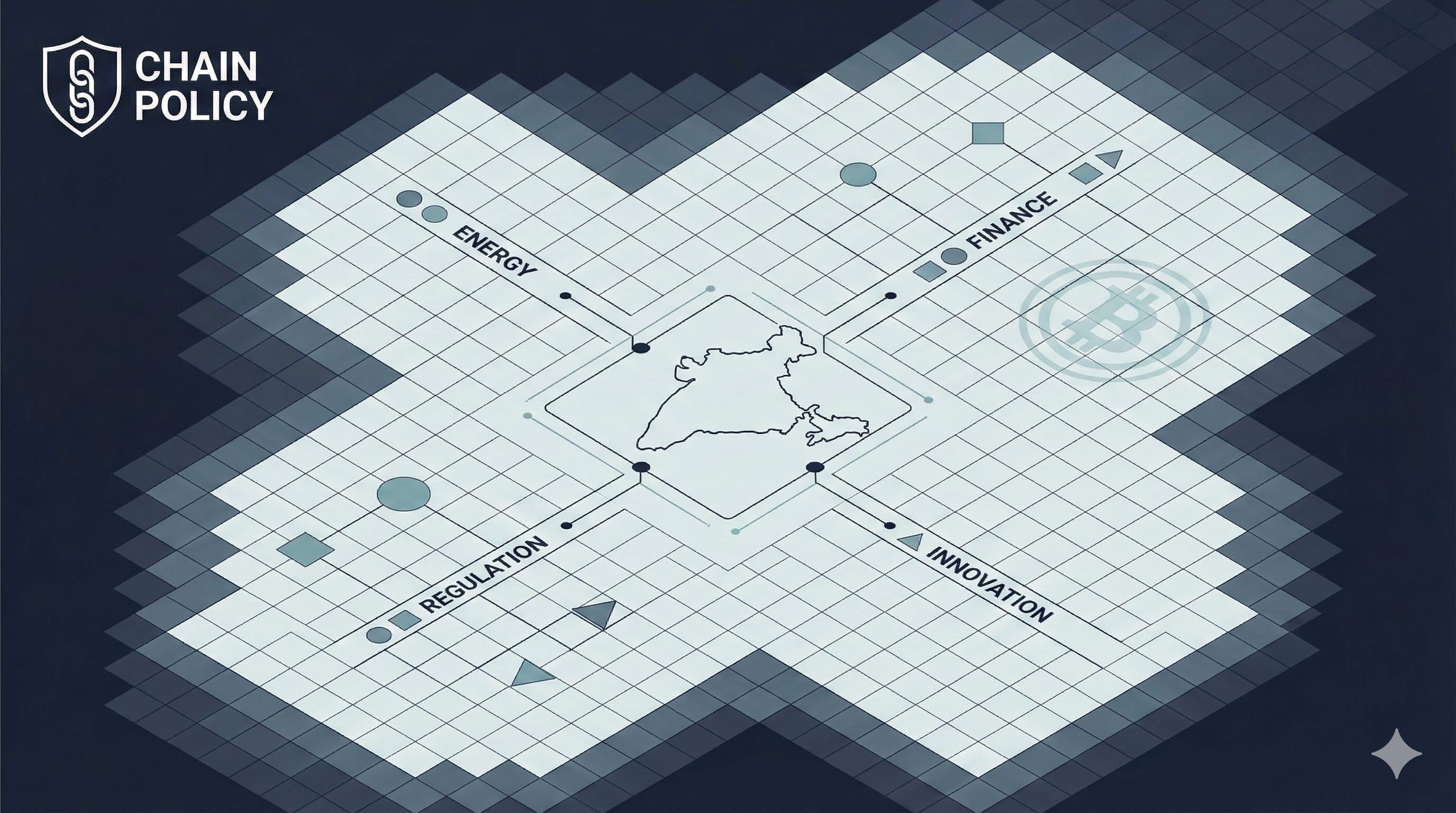
First, it should be the single public-facing point for national digital-asset policy consultation.
Just like companies have a single escalation channel for customer issues, India needs a single public channel for industry, academia, startups, and citizens to engage with government on digital assets.
Not ten different ministries.
Not twenty different desks.
One.
Second, it should internally coordinate across ministries.
This group should engage behind the scenes with RBI, SEBI, IRDAI, PFRDA, Finance, MeitY, the Energy Ministry, Home Affairs and National Security, and External Affairs, so that the public receives a coherent, unified, national-interest-aligned position.
Third, it must report directly to the PMO or Cabinet Secretariat.
This is crucial. If this group sits under a single ministry, its mandate will be constrained by that lens. Under the PMO, it gains the authority to reconcile conflicting perspectives and propose solutions that balance:
financial stability
energy opportunity
technological innovation
capital-account sensitivity
geopolitical autonomy, and
citizen protection
Fourth, it must focus on clarity, not a 10-year roadmap.
India does not need a 10-year plan. It needs clear definitions, clear jurisdiction, clear risk frameworks, clear on/off-ramp rules, clear guidance for institutions, and clear pathways for innovation.
The absence of clarity is what is pushing activity offshore and creating risk - not the absence of a 2035 roadmap.
Fifth, it must build trust by making consultations public and transparent.
This is not a backroom committee. It should:
publish consultation papers
invite citizen feedback
host open roundtables
release periodic updates
make the policy formation process legible to the public
- exactly how the U.K., Singapore, and the EU run public consultations, but adapted to India’s needs.
A single, empowered policy body.
Not a siloed cluster.
Not a 10-year plan.
A clear, visible place where India’s digital-asset policy is coordinated, debated, and shaped - and where stakeholders finally know whom to engage.
6. What’s In It for India - And Why I Care Personally
Let me end with both hats on: the macro-geek and the Indian citizen.
What India Gains
Strategic: optionality in a world where money and power are increasingly entangled, less vulnerability to single-system chokepoints.
Economic: new FX-earning industries, less blind gold-driven CAD, more tax revenue from an activity that already exists.
Political: alignment with youth and tech-forward voters, while still protecting vulnerable citizens from scams and excess leverage.
Institutional: better visibility, cleaner rules, reduced shadow activity, and the ability to influence global norms instead of only reacting to them.
Beyond the macro and the policy debates, I’ve also spent countless hours speaking with people across India - founders, miners, lawyers, academics, policymakers, and everyday Indians who are curious, cautious, confused, hesitant, or quietly participating already. Those conversations matter, because they reveal how real this shift has become on the ground.
And the more I see, the more I feel this:
India ignoring Bitcoin is not “safe”. It is strategically reckless.
Engaging with Bitcoin does not mean replacing the rupee or endorsing Bitcoin ideologically. It simply means:
understanding the asset properly
building clear and proportionate rules
using it where it strengthens India
limiting it where it threatens stability
In other words - doing what a confident, serious, rising civilization should do.
If this piece succeeds at anything, I hope it makes one thing impossible to say in good faith:
“Bitcoin doesn’t matter for India.”
Because it clearly does.
This trilogy is not an argument for Bitcoin maximalism. It is an argument for Indian strategic maturity. India does not need to “adopt” Bitcoin, embrace narratives, or rush into anything. All it needs is clarity, competence, and optionality. The world is changing - India deserves to be prepared, not reactive.
In case you missed Part 1, find it here.
In case you missed Part 2, find it here.
I write to bring clarity to how Bitcoin intersects with policy, regulation, and sovereign systems.
If this clarified something about Bitcoin and policy for you, you can subscribe to Chain Policy to receive future essays directly.
Every subscription is a vote for better conversations about Bitcoin policy.
And if this sharpened your perspective, take a few seconds to share it — it might help shape how someone else understands Bitcoin and policy.