


Before we discuss what India should or shouldn’t do, we need to understand why this conversation exists at all. Policymakers are not facing a “crypto fad”; they are facing a global monetary transition.
This article sets the global context that makes Bitcoin strategically relevant — not as hype, but as a structural shift India cannot ignore.
Why India Cannot Ignore Bitcoin: A National-Interest Case for Strategic Engagement
A new global monetary architecture is forming. India can either help shape it - or inherit it on someone else’s terms.
Bitcoin is no longer a curiosity you can dismiss with a joke about “internet money”. It has grown into a neutral, global monetary asset held by:
The world’s largest asset managers
Listed companies and treasuries
Energy producers
Several governments
And tens of millions of individual savers across every continent
I’m writing this not as a trader or a cheerleader, but as someone who has spent over two decades in analytics and strategy inside the banking and financial services system, watched multiple monetary regimes shift after crises, and spent the last several years deep in the weeds of Bitcoin, policy, energy, and global macro.
From that vantage point, I’ve come to a simple conclusion:
Indian policymakers can no longer afford to ignore Bitcoin.
Not because it is perfect, but because it is strategically relevant — to our monetary sovereignty, our energy economics, our long-term economic competitiveness, and our geopolitical leverage in a multipolar world.
This article is my attempt to lay out why, in the clearest language I can.
1. The World’s Money System Is Changing - With or Without India
For decades, the world has run on a USD-centric system. That system is now fraying at the edges:
Countries are diversifying reserves
Sanctions and financial warfare are more common
Global debt and money printing have exploded
Trust in traditional financial institutions is eroding
Younger generations instinctively reach for digital forms of value
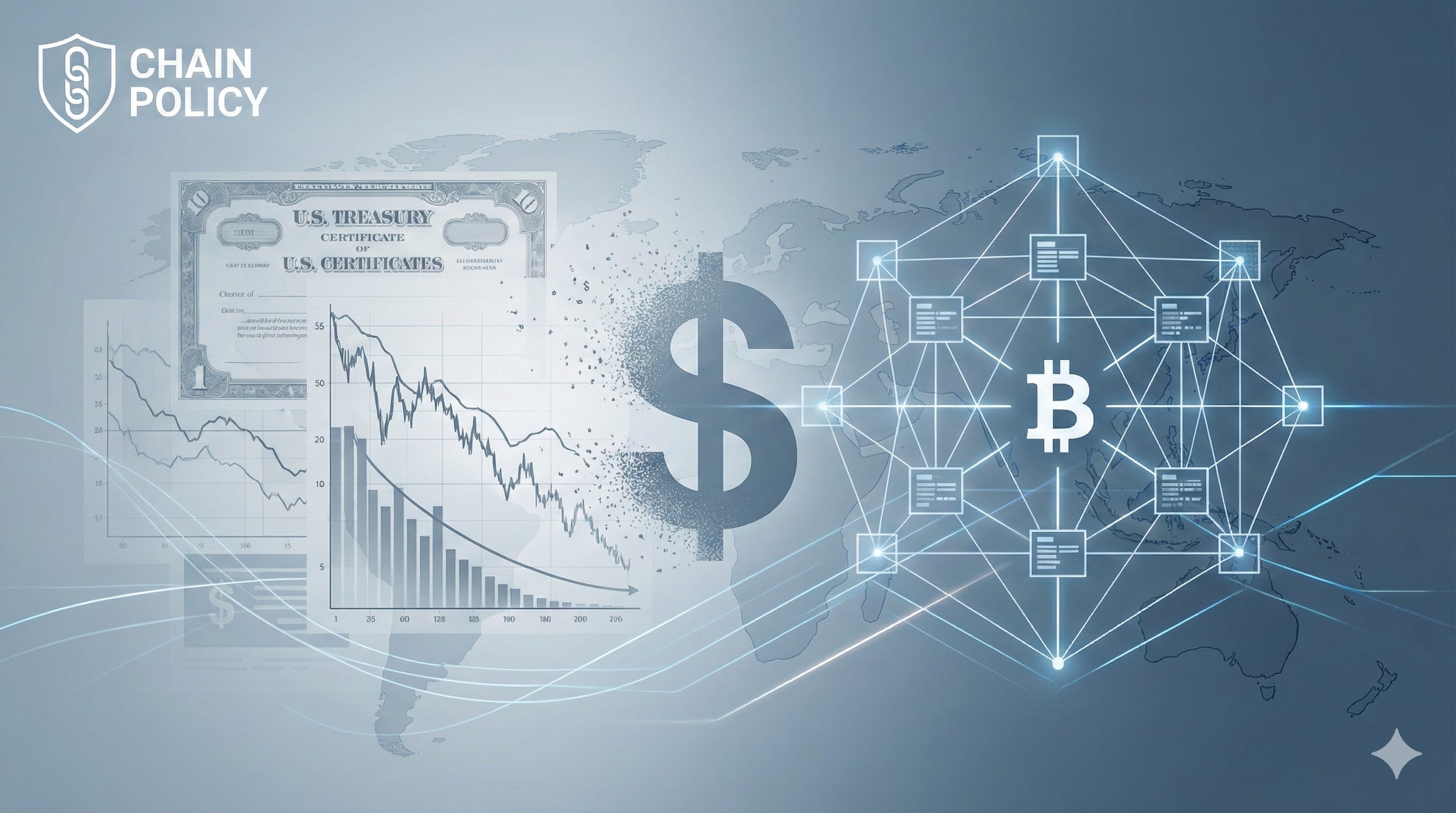
In that transition, Bitcoin has quietly become a serious candidate for “neutral, non-sovereign reserve asset” - not replacing the dollar, but sitting alongside:
Gold
US Treasuries
High-grade sovereign bonds
Whether we like Bitcoin or not is almost beside the point. It is now part of the global monetary conversation.
For India, a country that aspires to great-power status in a multi-polar world, the real question is:
Do we want to be part of that conversation - or be policy-takers from other first-mover countries when the dust settles?
2. The Decline of Trust in U.S. Treasuries - and the Sovereign Shift Toward Gold
One of the least-discussed but most important trends in global finance is the steady decline in foreign demand for U.S. Treasuries. For decades, Treasuries were treated as the risk-free backbone of the international monetary system. That assumption is no longer unquestioned.
China, once the world’s largest foreign holder of U.S. debt, has been reducing its Treasury exposure for more than a decade, with holdings dropping from over $1.3 trillion to under $800 billion. Other major reserve holders - Japan, Saudi Arabia, Russia (pre-sanctions), and multiple ASEAN economies - have similarly scaled back their purchases or diversified into alternative reserves.
At the same time, global central banks have been aggressively buying gold, not selling it. The World Gold Council reports that central banks have now been net buyers of gold for 14 consecutive years, with China, Poland, Singapore, India, Turkey, and other emerging economies leading the accumulation.
This is not random.
It reflects a growing realization that:
Geopolitical tensions
Sanctions risk
Weaponization of financial rails
Long-term fiscal deterioration
U.S. political polarization
…make Treasuries less “neutral” than they used to be.
Gold is the traditional alternative - a non-sovereign store of value that cannot be frozen or debased.
Bitcoin now enters the conversation not as a replacement, but as a digital complement to gold - portable, verifiable, liquid, programmable, and accessible across borders without permission.
So when sovereigns simultaneously begin:
Reducing Treasury exposure
Increasing gold accumulation
And (as now documented) holding Bitcoin reserves
…it signals a quiet but significant shift:
The world is looking for reserve assets outside the political control of any single nation-state - especially the United States.
For India, which seeks genuine strategic autonomy in a multipolar world, this trend cannot be ignored.
3. Why Bitcoin Is Rising Globally (Without the Hype)
Let me strip this down to the drivers that actually matter.
3.A — Hedge Against Fiat Instability (Especially Outside the West)
Globally, people have watched:
Central banks expand balance sheets massively
Inflation hit multi-decade highs
Currencies devalue catastrophically in many nations (Turkey, Argentina, Lebanon and others)
In that context, Bitcoin’s appeal is simple:
Fixed supply (21 million)
Predictable issuance schedule
No dilution at the whim of any government or central bank
Is it volatile? Absolutely.
Does that volatility make it useless? Not if your local currency regularly dies.
From an Indian lens, this matters because:
We import inflation through commodities and global capital cycles
Our savers look for ways to protect purchasing power over decades, not quarters
Youth are increasingly comfortable holding digital assets as part of their savings mix
Bitcoin functions as a long-term hedge against monetary debasement - not because it tracks CPI in the short term, but because it is the only major asset on the planet with a fixed supply. As global money supply expands and fiat purchasing power erodes, Bitcoin’s scarcity becomes more valuable over multi-year horizons. It protects savings not on a month-to-month basis, but across cycles - which is ultimately what matters for households, youth, and long-term national wealth.
3.B — Bitcoin vs Gold (And India Is a Gold Superpower)
India is obsessed with gold. I say that with affection.
Gold is:
A store of value
A cultural asset
A marriage system input (!)
A macro variable that shows up in our current account deficit and rupee dynamics
Bitcoin is increasingly framed globally as “digital gold”:
Scarce, like gold (arguably more predictable in its supply)
But far easier to store, move, split, and verify
For younger Indians who grew up with UPI, QR codes, and digital wallets, the idea that you can store long-term value in a digital bearer asset isn’t strange at all.
For many of them:
Gold is their parents’ language; Bitcoin is theirs.
If over the next decade, even 10–15% of marginal global “store-of-value demand” shifts from gold into Bitcoin, India will feel it across:
Gold imports
Household savings preferences
Rupee stability
RBI’s policy space
We can’t afford to treat Bitcoin as a tech curiosity while it quietly competes with our favourite monetary metal.
3.C — Bitcoin Is Now Deeply Liquid and Globally Integrated
Bitcoin trades:
24/7 across the world
On spot markets, derivatives markets, and now regulated ETFs
With deep order books and institutional custody
It has:
Survived multiple 80% drawdowns
Continued producing blocks every 10 minutes
Fought off forks, bugs, and governance battles
And despite all the drama, it’s still here — bigger every cycle.
Meanwhile:
India is consistently at the top of global crypto adoption indices (Chainalysis 2025 Global Adoption Index)
Indian users are active on global exchanges
Indian capital is flowing into Bitcoin exposure abroad whenever domestic rules are unclear or hostile
3.D — Bitcoin Mining as an Energy & FX Tool (Not Just a Headline Risk)
3.D.1 — The Misplaced “Energy Waste” Critique
“Bitcoin mining wastes energy” has been a criticism since the beginning — but it has always felt like selectively applied outrage.
Nobody questions how much energy the global banking system consumes, or how much electricity is used by AI data centers, or how much power is wasted every day in homes and offices by devices running idle.
Yet for some reason, Bitcoin alone becomes the target.
3.D.2 — What Mining Actually Does (Global → Indian Context)
3.D.2.A — How mining behaves (global mechanics)
In reality, Bitcoin mining behaves very differently from how critics imagine. Miners seek out the cheapest, most underutilized energy in the world - because their profit margin depends entirely on low-cost electricity.
Those energy sources are almost always:
Surplus hydro in remote regions
Curtailed solar and wind
Stranded power far from demand centers
Flared gas that is currently burned into the atmosphere
Mining gravitates to energy that no one else can use. It converts waste into value.
Mining has real-world energy benefits. Because miners can turn on and off quickly, they can act as:
Flexible, interruptible loads
Buyers of last resort for surplus or stranded energy
Stabilizers for renewable-heavy grids
FX earners via converting electricity to a global digital asset
3.D.2.B — The Indian opportunity (domestic relevance)
Now place this in an Indian context:
Surplus solar potential in Rajasthan & Gujarat
Untapped hydro in the Northeast and Himalayas
DISCOM financial stress
Increasing renewable commitments
A strategic need to boost exports and rural incomes
A carefully designed, tightly regulated Bitcoin mining framework could sit at the intersection of:
Energy policy
Rural development
FX earnings
“Make in India” for digital commodities
This is exactly the kind of multi-dimensional policy opportunity that becomes attractive once policymakers see past the speculative headlines and understand the underlying mechanics.
3.D.2.C — The global precedent (why India cannot afford to ignore this)
Globally, major energy companies have already begun treating Bitcoin mining as a way to monetize wasted or stranded power. U.S. oil producers have used flare gas to run modular Bitcoin-mining units instead of burning it. Nuclear and hydro plants in the U.S. have experimented with co-locating mining to absorb baseload power that has few alternative buyers. Some of these pilots have since expanded into broader “energy + compute” models that convert unused energy directly into revenue.
If Indian energy giants — Adani, Reliance, Tata Power, NTPC and others — ignore this trend for too long, they risk watching their global peers develop a capability India does not:
the ability to turn stranded electrons into digital assets and exportable compute power.
India doesn’t need to industrialize Bitcoin mining tomorrow, but it cannot afford to fall behind on understanding a tool that fits naturally with our renewable ambitions, curtailment challenges, and FX needs.
3.D.3 — The Security Logic Behind the Energy
Another point that most people miss is that Bitcoin’s security comes from this energy. The cumulative cost of mining acts as a massive economic wall. To rewrite even a few recent blocks, an attacker would need:
Enormous specialized hardware
Access to huge amounts of cheap electricity
The ability to control majority hashpower for a sustained period
At Bitcoin’s current scale, this is economically irrational and logistically implausible. As the network grows, the cost of an attack grows faster — making Bitcoin more anti-fragile over time, not less. This energy is not “waste”; it is the very mechanism that makes the network resilient, neutral, and secure.
3.E — Wall Street’s Bitcoin ETFs Changed the Game
When BlackRock, Fidelity and others launched spot Bitcoin ETFs, something structurally changed:
Bitcoin entered retirement accounts and institutional mandates
Exposure became a simple ticker symbol
Compliance teams got more comfortable
Demand became more “automatic” as part of balanced portfolios
Practically, this means:
Bitcoin has been admitted into the mainstream global financial stack
Even conservative allocators can put 0.5–2% into it without touching a hardware wallet
If the largest asset managers in the world are restructuring product shelves around Bitcoin, India’s policymakers at least need to ask:
“What happens to us if we pretend this doesn’t exist?”
The honest answer is: we lose control over something our citizens will interact with anyway.
3.F — Corporate Treasury Playbooks - Strategy, Not Just Speculation
MicroStrategy (now literally renamed “Strategy”) showed that a company can:
Use surplus cash and capital markets
Accumulate a large Bitcoin position
See its equity trade at a premium as a quasi-Bitcoin vehicle
Other companies are now following — in the US, Japan, Europe.
I’m not arguing every Indian corporate should pivot to a Bitcoin balance sheet. Far from it.
But I am saying: denying them the option by regulatory ambiguity doesn’t protect them — it just keeps them structurally behind global competitors.
3.G — Nation-States Are Quietly Accumulating Bitcoin
El Salvador grabbed global headlines for making Bitcoin legal tender — but the more important trend today is that sovereigns around the world have quietly begun accumulating Bitcoin on their balance sheets.
According to compiled public disclosures, court-seizure data, and treasury filings, 11 countries now officially hold Bitcoin, with combined holdings of ~645,000 BTC — representing ~3.07% of the entire global supply and worth approximately $59 billion at current prices.
This list includes:
El Salvador (the first nation to adopt BTC as legal tender)
Bhutan (actively mining Bitcoin with surplus hydro)
Ukraine (holding seized BTC plus wartime donations)
USA (holding seized Bitcoin through DOJ, Marshals Service, IRS, Homeland Security)
Germany, UK, Bulgaria, Finland, Georgia, Australia, Kazakhstan
Several others managing seized BTC reserves
The important point is not that all these governments “believe” in Bitcoin. Many of these holdings began as law-enforcement seizures, but instead of selling them immediately (as was the norm a decade ago), governments are now choosing to hold, manage, auction strategically, or integrate BTC into treasury workflows.
That is a quiet but meaningful shift.
Even more interesting for India is Bhutan — right in our neighborhood — which has leveraged cheap hydropower to mine and accumulate Bitcoin as a sovereign asset, effectively turning surplus energy into digital reserves that can be held, traded, or collateralized.
When 11 countries own a combined 645,000 BTC, the right question for India is no longer:
“Is Bitcoin legitimate?”
The right question is:
“What does it mean when sovereigns begin treating Bitcoin as a monetary reserve, even informally — and what optionality are we giving up by staying out of the conversation?”
For a country with India’s global ambitions, that silence creates a strategic blind spot.
Closing
If global systems are shifting and sovereigns are repositioning themselves, the natural next question becomes:
“What does all this mean for India specifically?”
In Part 2, we move from global forces to India’s strategic interests — monetary sovereignty, competitiveness, youth behaviour, and national security.
What Comes Next
If global systems are shifting and sovereigns are repositioning themselves, the natural question becomes:
What does all this mean for India?
Part 2 moves to India’s strategic interests:
monetary sovereignty, competitiveness, youth behaviour, and national security.
Why India Cannot Ignore Bitcoin (Part 2): What This Means for India — In Plain Strategic Language

Now that we’ve seen how the global monetary landscape is changing, the next question is simple:
I write to bring clarity to how Bitcoin intersects with policy, regulation, and sovereign systems.
If this clarified something about Bitcoin and policy for you, you can subscribe to Chain Policy to receive future essays directly.
Every subscription is a vote for better conversations about Bitcoin policy.
And if this sharpened your perspective, take a few seconds to share it — it might help shape how someone else understands Bitcoin and policy.