


Something about the current moment in global finance feels deeply ironic.
Bitcoin was built to offer an alternative to fiat. To inflation. To centralized monetary control. It was born in the shadow of the 2008 crisis, as a response to the fragility of the system.
And yet today, in 2025, it’s the United States — the very empire Bitcoin was supposed to disrupt — that’s running hardest with it.
Wall Street has embraced it. BlackRock and Fidelity are deep in. The U.S. now controls the largest share of global Bitcoin mining. And under Trump’s second term, the Republican narrative has shifted: Bitcoin isn’t just tolerated — it’s being framed as a tool for economic freedom, energy leverage, and resistance to centralized digital currencies like CBDCs.
Now, to a lot of people in the Bitcoin ecosystem, this might seem like validation.
But to those watching from outside the U.S. — especially from countries that have long been at the receiving end of American monetary power — this shift is harder to swallow.
Because if Bitcoin starts to look like a U.S. asset, co-opted by its political and economic establishment… does it still function as neutral global money?
That’s the uncomfortable question we now need to face.
What the U.S. Is Actually Doing
This isn’t some libertarian fringe movement anymore. It’s coordinated strategy.
The U.S. is hedging its own decline by backing the rails of a new system. Instead of fighting Bitcoin, it’s absorbing it — through:
Institutional vehicles (ETFs, trusts, retirement access)
Mining and custody infrastructure
Legal protection for self-custody and decentralized protocols
Narratives around economic freedom and resistance to surveillance
And with Trump back in power, the message is getting sharper:
CBDCs are framed as state control.
Bitcoin is being positioned as the digital counterweight.
Energy producers are integrating Bitcoin into their monetization strategies.
All of this benefits Bitcoin — price, legitimacy, adoption. No question.
But it also changes how Bitcoin is perceived around the world.
How the Rest of the World May React
If you’re sitting in Moscow, Tehran, or even New Delhi, watching Bitcoin get swept into the U.S. political fold, the optics start to get tricky.
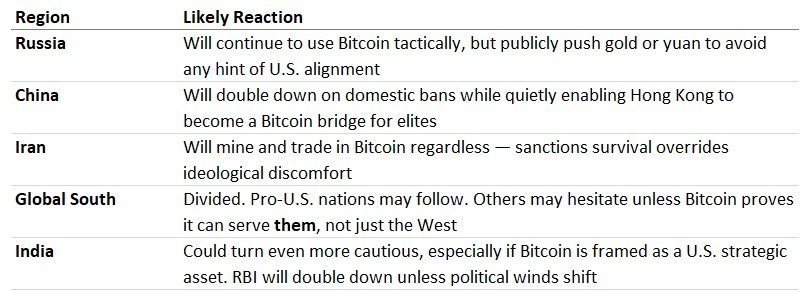
The irony is thick: The more the U.S. embraces Bitcoin, the harder it may become for other countries to see it as independent of American power.
But Here’s the Thing: Bitcoin Still Isn’t America
This is the part we can’t afford to forget.
Yes, the U.S. may lead in adoption right now.
Yes, it may host more miners, more ETF issuers, and more lobbying groups.
But Bitcoin isn’t owned by the U.S. — or anyone.
It’s open-source. Permissionless. Borderless.
Anyone can run a node. Anyone can verify the ledger.
No one — not even the U.S. — can rewrite the protocol or censor transactions.
Bitcoin’s decentralization isn’t just a technical feature. It’s a geopolitical shield.
It’s the reason any country — including those with reasons to distrust the U.S. — can still use it.
What Sovereigns Need to Understand
If you’re in government or policy circles in a country outside the U.S., the temptation might be to walk away from Bitcoin right now — just to avoid aligning with American interests.
But that’s a mistake.
Bitcoin isn’t the new dollar. It’s the anti-dollar.
And if the U.S. is embracing it, it may be doing so out of weakness, not strength.
Don’t ignore Bitcoin because America is early to the table.
Join the table. Bring your own fork.
Accumulate it.
Mine it.
Use it for trade.
Custody it yourself.
Set the standards alongside others.
Bitcoin will only stay neutral if enough diverse players make it neutral. It’s not a finished product. It’s a protocol that reflects the incentives of those who participate in it.
Closing Thought
If only the U.S. adopts Bitcoin, it will begin to look like another U.S. asset — whether it is or not.
But if the rest of the world participates — if we build infra in Asia, custody in Africa, mining in Latin America, wallets in the Middle East — then Bitcoin becomes what it was meant to be:
Not American. Not Chinese. Not state-controlled.
But everyone’s.
And that only happens if we show up.
Companion Read: What Should India Do About Bitcoin?
For a nation-specific lens on Bitcoin strategy, check out this related essay:
India at a Bitcoin Crossroads: Shape the Future or Play Catch-Up
A policy lens on India’s pivotal decision: embrace Bitcoin as strategic infrastructure or fall behind in the new monetary order
While this article explored how U.S. political alignment with Bitcoin could reshape global perceptions, the India piece dives into the contrasting paths available to one of the world’s largest democracies—highlighting what’s at stake if India delays or misreads the moment.
I write to bring clarity to how Bitcoin intersects with policy, regulation, and sovereign systems.
If this clarified something about Bitcoin and policy for you, you can subscribe to Chain Policy to receive future essays directly.
Every subscription is a vote for better conversations about Bitcoin policy.
And if this sharpened your perspective, take a few seconds to share it — it might help shape how someone else understands Bitcoin and policy.